Fibonado
Fibonado is a time management technique. This is an improved way to time-boxing, addressing issues of Pomodoro approach. Fibonado helps to reach maximum productivity during work. It also helps to:
- raise motivation naturally;
- move yourself into flow state;
- start complex tasks easy.
Technique description
For Fibonado use we need:
- countdown timer;
- remember Fibonacci numbers sequence - 2, 3, 5, 8, 13, 21, 34, 55. Notice that each next number is a sum of two numbers going before it.
Starting a new task, set a timer for 2 minutes. Number of minutes is a number in a Fibonacci sequence. Do task, when timer rings, make decision:
- Continue working, set a timer for the next amount of minutes according to the sequence.
- Switch to another task, setting timer on start value in the sequence.
- Have a break.
The decision by default - continue to work, stick with it as long as you have motivation to continue. If you feel that psychological resistance to continue for the next amount of minutes is overwhelming, switch to another. Do a break when you need it.
The magic
Technique is based on universal laws of nature. Fibonacci sequence aligned with emotional readiness to continue work on the current task. Starting from short period of commitment to the task, no matter how unpleasant or complex it is, your readiness to continue is increased a little bit. Fibonacci sequence giving an answer what is an exact number of this 'a little bit' more. It is a golden ratio - an approximate proportion between timer intervals in Fibonacci sequence. In such a way, Fibonado technique helps to stay in comfort zone even with the most tedious task, while constantly increasing the summary time spent on it, guarantee inevitability of completion or progress.
Additional positive effect: when timer rings, it reminds you that one more time interval passed and before to start the next one you automatically giving yourself an answer on the question - is it completed? What is required to complete? Is there more efficient way to spent the next interval? It helps to get result quicker and avoid unnecessary perfectionism.
What if...
...work on a task was interrupted by external circumstances? Then, when you return into the control zone, we make a decision, what task to take - previous one, maybe with modified description, or a new one. Algorithm of selecting task to take is out of Fibonado technique responsibility - feel free to use Getting Things Done or Final Version Perfected or any other approach. When task is selected, start the first timer.
What if you need to start the next interval, e.g. 18 minutes, but you have only 7 before scheduled meeting? Then stop to use timers and just continue to work before the meeting. Maybe even better decision is to take a break.
What if after the first interval you out of motivation to carry on with the task? Check, if there is at least small progress. If not - start the next timer and continue to work until there is such with focus on the result. After that we switch to another task.
What if there is no timer at hand? Buy one, use software, Windows has a great default one, smartphones have it too. Alternative - smartwatch, in this case you will have it with you anywhere. At last you can use ordinary clock to acknowledge yourself, is it time to switch or continue.
What if there is only one task-project-goal? In such a case you can still use Fibonado to resolve issues with motivation to start, then stop use it when you are into a work flow. If issues with motivation are constant, make sense to cut down the project into different tasks and use the technique as usual.
How to squeeze more value from Fibonado
Amount of minutes on a timer could be modified, it is not necessary 2, 3, 5, 8. Consider the following criteria:
- The first interval - minimum amount of time you can allocate to ANY task, independently of it's complexity and your emotional readiness to work on it. And it should be probability to have at least some progress after it. From 2 to 5 minutes usually works well for start.
- The next timer - the previous one multiplied on golden ratio (~1.6). Then just sum the two previous and build the whole sequence.
- Feel free to round up a little bit to make emotionally pleasant numbers in case of need.
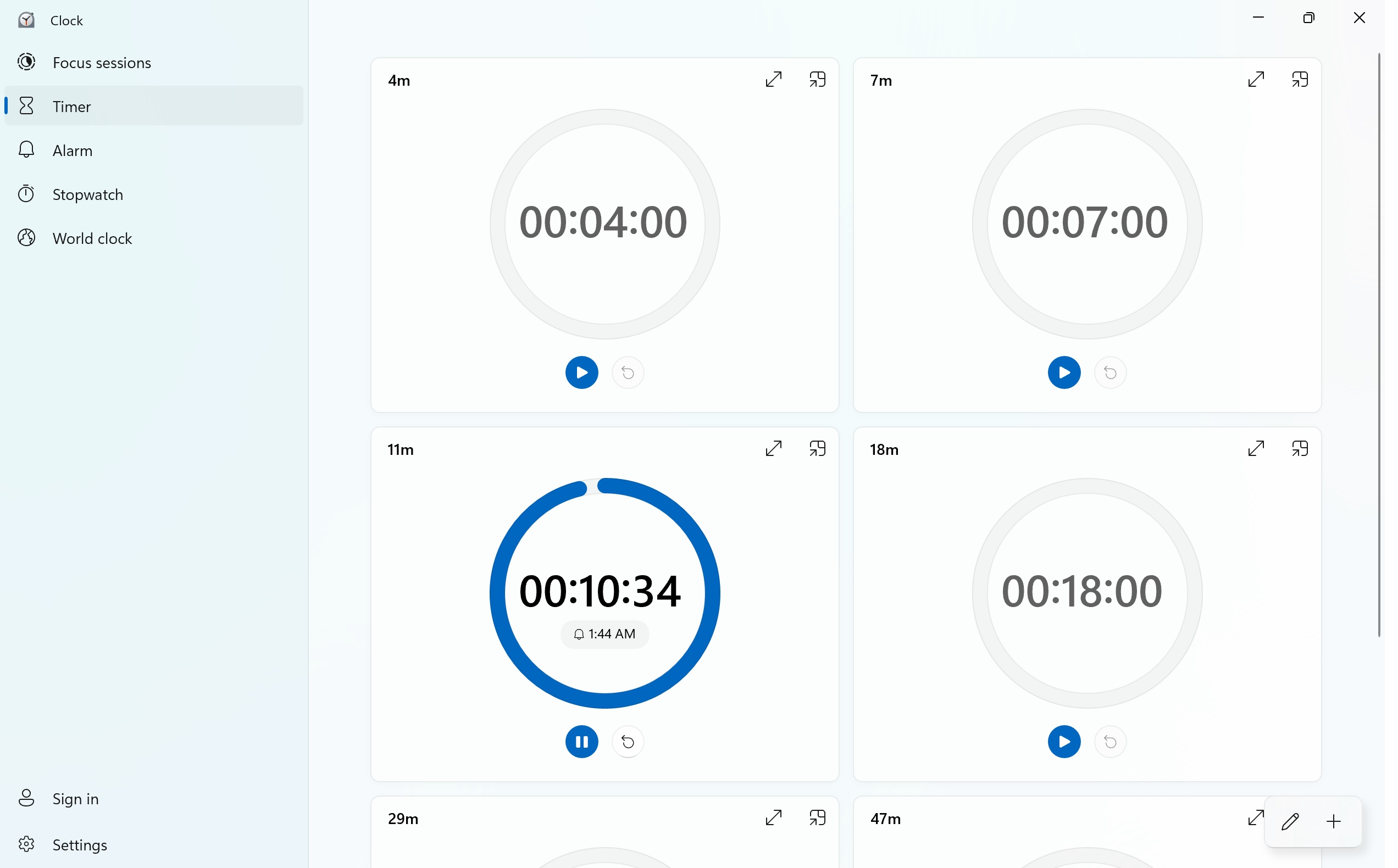
For example my favorite sequence is 4 (minimal interval I can take), 7 (4*1.6 and round up), 11 (4+7), 18(7+11), 29(11+18), 47 (18+29, rarely come to it, as the task either have already been completed or it is time to have a break).
This is how it looks like in built-in Windows 11 Alarms & Clock application on Timer tab:
When is the perfect time to start the timer? When you just started to work on the task. If you need to find the document or open an url before that - do that first and then press start.
Fibonado technique helps to do house chores too. You will have another amount of distractions but it does not matter as technique copes with distractions well. You can always start from the beginning of sequence after losing of focus or motivation.